
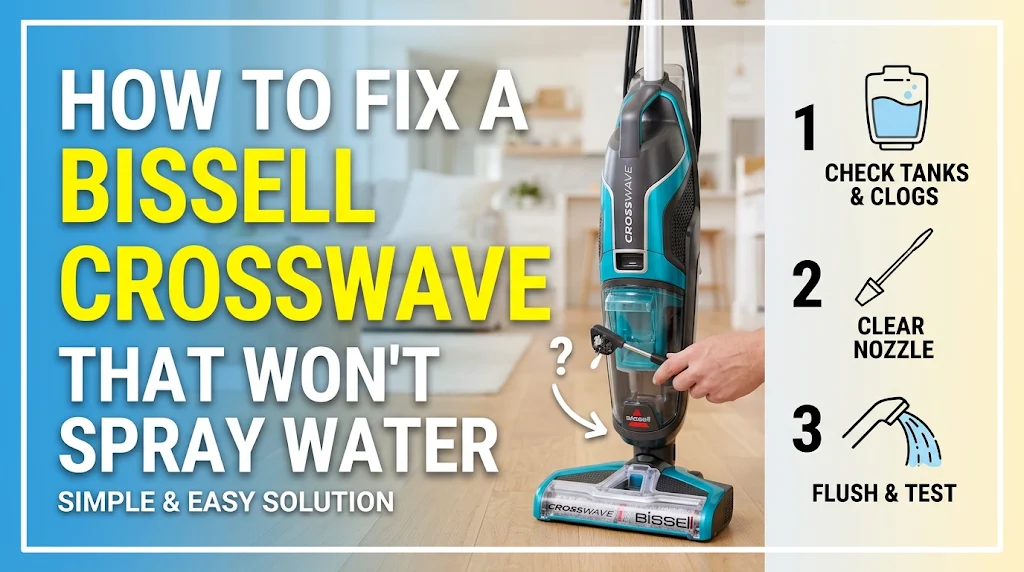
There is nothing quite as frustrating as setting aside Saturday morning for deep cleaning your floors, only to fill up your Bissell CrossWave, pull the spray trigger, and hear the motor whirring while absolute dryness comes out of the foot. The Bissell CrossWave is an engineering marvel for busy homeowners, combining vacuuming, washing, and drying into a single swift pass. However, because it manages both suction and liquid distribution simultaneously, its fluid delivery system relies on a delicate balance of pressure, seals, valves, and unblocked nozzles.
When your CrossWave refuses to dispense cleaning solution or water, it is rarely a sign that you need to throw it away and buy a new one. In most cases, the issue stems from a minor airlock, mineral scale buildup, a sticky tank valve, or a partial clog in the spray tip.
This comprehensive, step-by-step guide walks you through the exact diagnostic and repair workflow used by appliance repair technicians to restore full spraying functionality to your Bissell CrossWave.
Understanding How the Bissell CrossWave Spray System Works
Before diving into wrenches and cleaning pins, it helps to understand how liquid travels through your machine. Knowing the pathway makes it much easier to isolate where the failure is occurring.
The Clean Water Tank: Located at the back of the machine, this tank holds your clean water and formula mixture. At the base is a spring-loaded valve plug.
The Machine Receiver Valve: When the tank is locked into the machine, a post depresses the tank valve, allowing water to gravity-feed downward into the internal plumbing.
The Water Pump: When you pull the spray trigger on the handle, an electrical signal activates a small internal water pump that pulls fluid from the tank reservoir.
The Solution Tubing & Spray Nozzle: The pump forces the liquid through an internal hose leading down to the foot of the vacuum, where it exits via a spray tip or nozzle situated just above the rotating brush roll.
If any single link in this chain is obstructed—whether by an air bubble, a grain of mineral deposit, or pet hair wrapped around the foot assembly—the spray function will sputter or stop entirely.
Step 1: Check and Reseat the Clean Water Tank
The absolute most common culprit behind a Bissell CrossWave that won’t spray is the clean water tank not making a proper seal with the intake valve on the machine body. Over time, plastic wear or minor debris can prevent the tank from clicking securely into place.
How to Inspect and Fix It:
Power Off and Unplug: Always disconnect your machine from the wall outlet before performing maintenance.
Remove the Tank: Lift the clean water tank straight up and off the back of the machine.
Inspect the Valve and O-Ring: Look at the black cap assembly at the bottom of the tank. Ensure the rubber O-ring is seated flat and is not twisted, cracked, or missing.
Check the Spring Mechanism: Press down firmly on the center spring-loaded valve pin with your finger. It should spring back up smoothly. If it feels stuck or gummed up with old, sticky floor cleaner, soak the cap in warm water for 10 minutes.
Re-seat Firmly: Place the tank back onto the machine housing and push down firmly until you hear an audible click. A loose tank cannot pull water into the pump.
Pro Tip: If your tank is leaking or the valve pin does not bounce back freely, a replacement cap assembly is inexpensive and instantly resolves intermittent spraying issues caused by air leaks.
Step 2: Unclog the Brush Roll Window and Spray Nozzle
If your tank is seated correctly and you can hear the pump running when you pull the trigger, but nothing sprays out, the blockage is almost certainly located at the foot of the machine—specifically around the spray nozzle and brush roll window.
Over weeks of cleaning, fine carpet fibers, pet hair, and sticky residue can accumulate around the spray tip opening. Furthermore, hard water minerals can calcify inside the microscopic spray holes.
Step-by-Step Cleaning Guide:
Remove the Brush Roll Cover: Press the buttons on top of the brush window and pull it forward to remove it.
Remove the Brush Roll: Twist the brush roll tab and pull it out. Set it aside.
Locate the Spray Nozzle: Look at the upper inside arch of the foot where the window was attached. You will see a small plastic strip containing tiny spray holes (or a single central slot depending on your specific CrossWave model).
Clear the Orifices: Take a straightened paperclip, a sewing needle, or a toothpick and gently poke it into each tiny spray hole to dislodge mineral buildup or debris.
Wipe Down the Housing: Wipe away any accumulated hair or grime around the nozzle area with a damp microfiber cloth.
Example: If you live in an area with hard water, white crusty calcium deposits often build up over the spray ports within 3 to 6 months. Cleaning these monthly with a vinegar-soaked Q-tip prevents sudden clogs.
Step 3: Prime the Pump and Clear Internal Air Locks
Sometimes, if your CrossWave runs completely dry or sits unused for a few weeks, an air bubble forms inside the internal water pump. When this happens, the pump spins, but it becomes “air-locked” and cannot create the suction needed to pull water forward.
How to Prime the Pump:
Fill the Tank with Warm Water: Fill the clean water tank to the water line with warm (not boiling) tap water and a small amount of Bissell formula. Do not use boiling water, as it can warp plastic components.
Elevate and Pump the Trigger: Hold the spray trigger continuously for 15 to 30 seconds while the machine is upright and turned on.
Gently Shake the Machine: While holding the trigger, gently rock the machine back and forth. This motion helps dislodge trapped air bubbles in the internal tubing line.
Listen to the Pitch: Pay attention to the sound of the pump. When it is dry or air-locked, it often emits a higher-pitched whir. Once water successfully enters the impeller chamber, the sound will deepen slightly as it works under load.
Step 4: Inspect the Dirty Water Tank and Float Stack
It sounds counterintuitive, but a problem with your dirty water tank can actually prevent your clean water tank from spraying. The Bissell CrossWave features a safety mechanism designed to protect the vacuum motor from liquid overflow.
Inside the dirty water tank, there is a plastic cage containing a floating disk (the float stack). If this float gets stuck in the “up” position—due to accumulated debris, foam from too much soap, or improper assembly—the machine’s suction system gets disrupted, which can interfere with overall fluid dynamics and pressure regulation.
How to Fix It:
Remove the Dirty Water Tank: Unlatch the top of the dirty water tank and pull it off the machine foot.
Check the Float: Inspect the foam filter and the plastic float cage underneath the lid. Ensure the floating disk moves freely up and down when you tilt the tank.
Wash and Dry: Rinse out the tank and float stack thoroughly with warm water. If excess suds caused the float to stick, add a few drops of anti-foam solution or switch to a low-foaming cleaning formula.
Secure the Lid: Ensure the tank lid is snapped tightly into place before sliding the tank back into the machine body until it clicks.
Common Pitfalls and Mistakes to Avoid When Troubleshooting
When troubleshooting appliance issues, it is easy to make mistakes that worsen the problem or damage your investment. Keep these critical warnings in mind:
Avoid Harsh Chemical Solvents: Never pour bleach, ammonia, dish soap, or undiluted vinegar directly into your clean water tank. Dish soap creates excessive foam that ruins the float mechanism, while harsh chemicals degrade internal rubber seals and pump tubing.
Never Use Boiling Water: Always use warm tap water. Boiling water will warp the clean water tank, crack the plastic foot window, and melt rubber check valves.
Do Not Force Stuck Parts: If the clean water tank valve pin is stuck, do not pierce it with a sharp metal tool or knife. Soak it in warm water or a 50/50 water-and-vinegar solution to dissolve mineral bonds naturally.
Don’t Forget Regular Flushing: After every use, run a cup of clean warm water through the machine on a cleaning tray to flush out residual detergent before it dries and hardens inside the spray channels.
Frequently Asked Questions (FAQs)
Can I use regular floor cleaner or dish soap in my Bissell CrossWave?
No. You should only use official Bissell CrossWave multi-surface or floor-specific formulas, or approved equivalent low-foaming multi-surface formulas. Standard household floor cleaners (like Pine-Sol or Murphy’s Oil Soap) create heavy foam that clogs the internal pump, triggers the dirty water tank shut-off float, and leaves a sticky residue on your floors.
Why does my CrossWave spray water intermittently instead of a steady stream?
Intermittent spraying is almost always caused by an imperfect seal on the clean water tank valve or an air bubble trapped in the line. Remove the clean water tank, check the rubber O-ring at the bottom, ensure the valve moves freely, and firmly click the tank back into position while holding the spray trigger down.
How do I know if the internal water pump is completely broken?
If you have verified that the clean water tank has water, the tank valve is opening correctly, the spray nozzle is completely unclogged, and you have primed the line, but you hear zero motor sound or vibration when pulling the trigger, the internal pump may have failed or lost electrical connection. In this case, inspecting the internal wiring or contacting Bissell customer support is recommended.
How often should I clean the spray nozzle on my CrossWave?
It is best practice to inspect and wipe down the brush roll window and spray nozzle area after every 3 to 5 cleaning sessions, especially if you have hard water or have been cleaning areas with high pet hair accumulation.
Conclusion and Final Call to Action
A Bissell CrossWave that won’t spray water can put a sudden halt to your cleaning routine, but as you have seen, the fix is usually quick, mechanical, and entirely DIY-friendly. By methodically checking your clean water tank valve, clearing mineral scale from the spray nozzle, priming the internal pump, and ensuring your dirty water tank float stack is moving freely, you can restore peak performance to your machine in minutes.
Don’t let a minor clog sideline your cleaning routine or prompt an unnecessary replacement. Take 10 minutes today to inspect your CrossWave’s spray path, clear out any mineral buildup, and get your favorite floor cleaner spraying like new again!
