
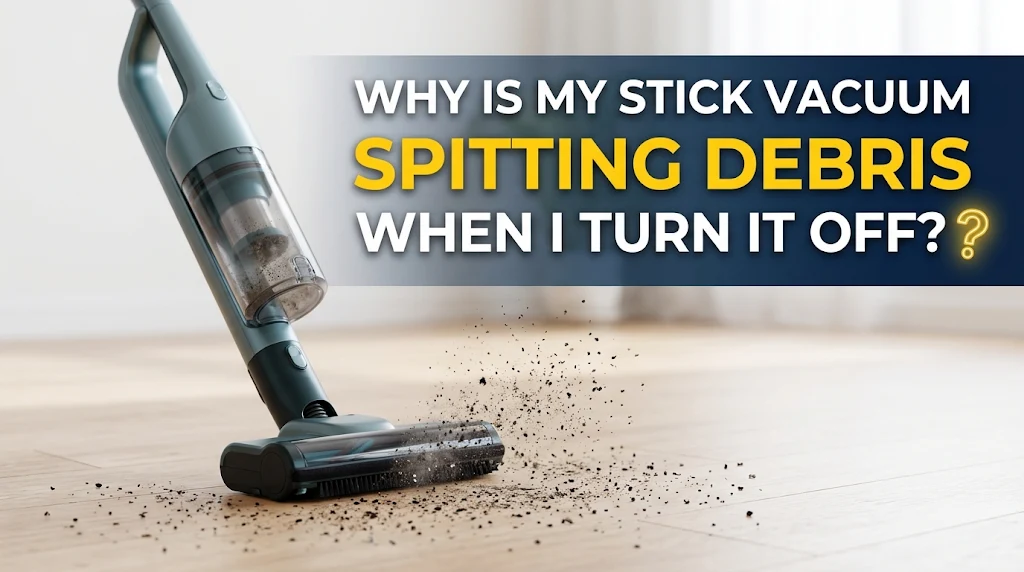
Picture this: You have just finished a thorough sweep of your hardwood living room floor. The room looks pristine, your cordless stick vacuum hums quietly as you press the power button to shut it down, and you feel that satisfying sense of accomplishment.
Then, right as the motor spins down to a halt, a small pile of crushed cheerios, pet hair, or coffee grounds tumbles right back out of the cleaning head onto the floor you just cleaned.
It is one of the most frustrating, counterintuitive quirks of modern cleaning appliances. You use a vacuum to pick up debris, not to dispense it back out like an unwilling mechanical butler. If your stick vacuum is spitting debris when you turn it off, you are certainly not alone. This is a common troubleshooting issue across popular cordless stick vacuums from brands like Dyson, Shark, Tineco, and LG.
In this comprehensive guide, we will break down the exact mechanical physics behind why this happens, walk you through step-by-scale troubleshooting solutions, highlight common pitfalls to avoid, and answer your most pressing vacuum maintenance questions.
1. The Physics of the Problem: Why Stick Vacuums Spill Debris
To understand why a vacuum drops dirt when powered down, we have to look at how a stick vacuum differs from a traditional upright or canister vacuum. Traditional vacuums usually rely on gravity to hold dirt downward into a bag or bin sitting at the bottom of the machine, often featuring physical or weighted check-valves (flap seals) near the intake.
Cordless stick vacuums, however, are engineered for lightweight maneuverability. Their architecture is inverted or compact:
High-Speed Motors and Cyclonic Separation: Stick vacuums spin air at tens of thousands of RPMs to generate suction. When the motor is running at full capacity, a column of fast-moving air pulls debris upward through the wand and traps it inside the upper dust cup using centrifugal force.
The Sudden Loss of Pressure: The exact millisecond you press the power button, the impeller fan begins to slow down. Suction drops from 100% to 0% in less than a second.
The Gravity Drop: During that split second of deceleration, any loose debris suspended in the neck, wand, or the lower intake throat of the cleaner head loses the upward momentum holding it against gravity. Without active suction pulling it upward, it falls straight back down through the floor nozzle.
Pro Tip: If your vacuum only drops one or two stray crumbs, it is often just normal residual debris caught in the throat of the brush roll housing. If it drops a significant pile, you are dealing with a blockage, a failing seal, or an airflow restriction.
2. Primary Culprits and Step-by-Step Fixes
Let us dive into the core mechanical issues that cause your stick vacuum to spit dirt upon shutdown, paired with actionable steps to resolve them.
Culprit A: A Clogged or Partially Blocked Wand/Neck
Over time, hair, carpet fibers, and larger debris can snag on microscopic imperfections inside the plastic wand or the flexible neck of the floor tool.
How it causes spitting: When the vacuum runs, debris forces its way past the partial clog under high pressure. When you turn the machine off, the debris resting just underneath or caught inside the restriction loses support and falls backward out of the intake.
The Fix:
Detach the stick vacuum from the wand and floor tool.
Shine a flashlight down the entire length of the metal or plastic wand.
Use a long, flexible brush or a broom handle wrapped with a damp cloth to push any lodged clumps of hair and dust completely out.
Inspect the flexible rubber hose joint connecting the wand to the motorized brush head for hidden blockages.
Culprit B: The Inlet Flap Valve is Stuck, Missing, or Damaged
Most modern motorized floor heads feature a small rubber or plastic one-way flap valve (often called a check valve or sealing flap) located right at the mouth of the suction inlet.
How it causes spitting: This tiny flap acts like a swinging door. When the vacuum is on, suction pulls it open inward. The second you turn the vacuum off, gravity and the back-pressure of falling air snap that flap shut, sealing the debris inside the vacuum head. If this flap is warped, jammed open with pet hair, or torn off entirely, debris slides right back out onto your floor.
The Fix:
Turn off and unplug (or remove the battery from) your stick vacuum.
Flip the floor head over and look directly at the suction intake opening.
Locate the rubber or silicone flap valve.
Clean away any wrapped hair or sticky residue preventing it from moving freely. If it is torn or deformed, order an OEM replacement floor head or valve component.
+-------------------------------------------------------------------------+
|                      CHECK VALVE INSPECTION CHECKLIST                   |
|                                                                         |
|  [ ] Is the rubber flap flexible and free of cracks?                    |
|  [ ] Does it swing completely shut on its own?                          |
|  [ ] Is pet hair or lint jamming the hinge mechanism?                   |
+-------------------------------------------------------------------------+
Culprit C: An Overfull Dust Cup or Blocked Cyclone Shroud
The dust cup is the heart of your vacuum’s storage system. If it is packed to the brim, there is nowhere for incoming debris to settle safely away from the intake path.
How it causes spitting: When the MAX fill line is exceeded, debris stacks up so high that it touches the bottom of the metal mesh shroud or cyclone cones. When you power down, the column of dirt sitting right at the throat of the intake spills back out through the wand.
The Fix:
Empty your dust cup before it reaches the designated MAX fill line—ideally after every heavy cleaning session.
Remove the cyclone assembly and wash or brush away fine dust caked around the shroud mesh. Fine dust acts like cement, restricting airflow and reducing the immediate capture efficiency of the bin.
3. Common Pitfalls and Mistakes to Avoid
When troubleshooting stick vacuum issues, homeowners often make errors that exacerbate the problem or damage their equipment. Keep these warnings in mind:
Mistake 1: Vacuuming Large, Rigid Objects. Stick vacuums are designed for fine dust, pet hair, cereal, and crumbs. Trying to suck up heavy nuts, bolts, large plastic pieces, or dense gravel can jam internal valves and crack plastic housings, preventing proper seals.
Mistake 2: Neglecting Filter Maintenance. Clogged HEPA or foam filters choke the motor. Reduced airflow means weaker suction at shutdown, failing to cleanly pull debris up into the bin. Wash your filters every month and let them dry for at least 24 hours before reinserting them.
Mistake 3: Storing the Vacuum Wet. Never reassemble damp filter components or dust bins. Wet dust creates a muddy paste inside the vacuum neck that cements hair and debris in place, immediately triggering back-spill issues.
4. Frequently Asked Questions (FAQ)
Why does my Dyson stick vacuum drop dirt when I turn it off?
This is typically caused by a jammed or missing inlet valve seal inside the cleaner head, or a partial clog in the wand. When the cyclone stops spinning, gravity pulls the loose debris resting in the neck back out through the bottom.
Can a clogged filter cause a stick vacuum to spit out debris?
Yes. A clogged filter severely restricts airflow. When you shut the vacuum off, the sudden pressure drop is erratic, allowing suspended particles in the intake tract to fall backward out of the nozzle instead of settling into the bin.
How often should I clean my stick vacuum’s brush roll and neck?
You should inspect and clear hair wraps from the brush roll every 2 to 3 weeks, and check the wand and intake neck for hidden clogs monthly to ensure optimal airflow and prevent debris drop-out.
Is it normal for a cordless vacuum to drop one or two crumbs upon shutdown?
A stray crumb or two falling out occasionally can happen due to gravity acting on residual dirt sitting right at the lip of the brush roll housing. However, if it drops a visible pile or happens consistently, it indicates a functional blockage or a faulty intake valve flap.
Conclusion
A stick vacuum spitting debris upon shutdown is more than just an annoying quirk—it is a clear diagnostic signal that your machine’s airflow, seals, or intake pathways need attention. By understanding how the rapid loss of suction interacts with gravity, inspecting your floor head’s check valve, clearing hidden wand blockages, and keeping your filters clean, you can restore your vacuum to peak performance.
Take a few minutes today to inspect your machine’s intake tract, clean out the dust bin, and enjoy a truly mess-free clean from start to finish!
